Teshima 豊島
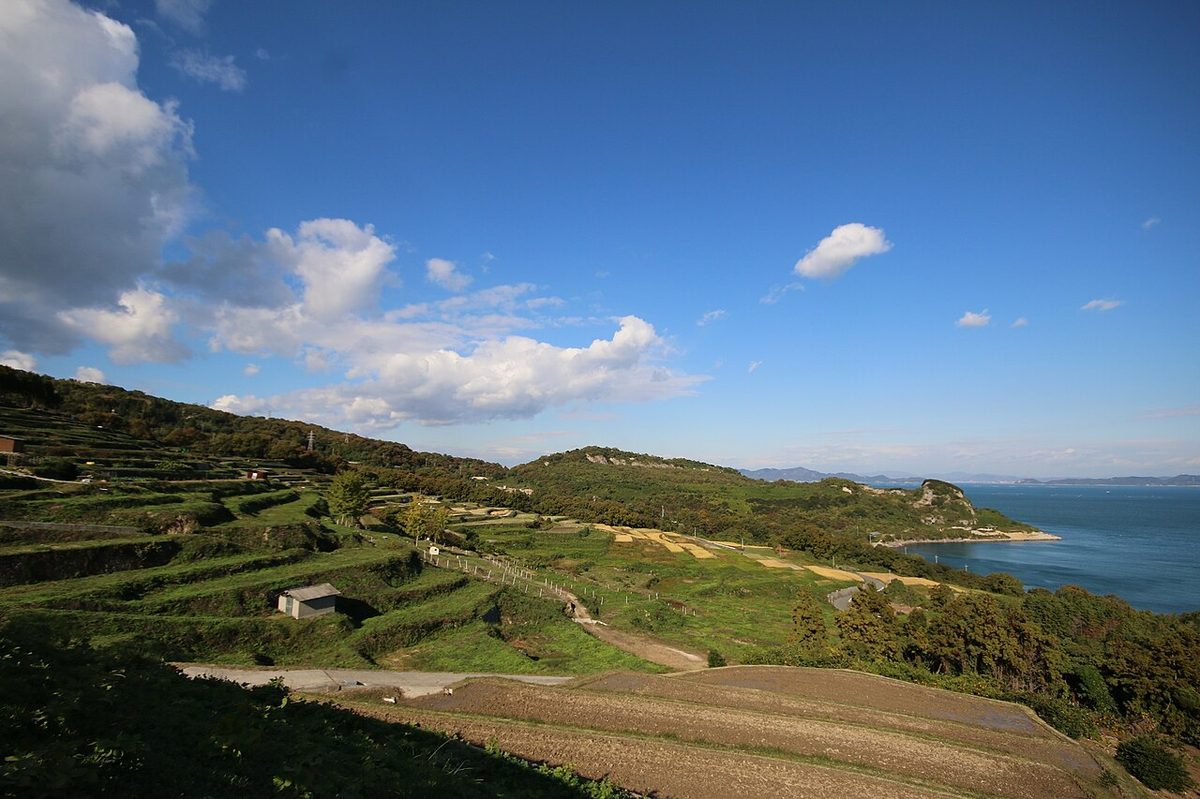

| Island group | Teshima |
|---|---|
| Prefecture | Kagawa |
| Region | Shikoku |
| Municipality | Tonoshō-chō |
| Population | 782 (2020) |
| Area | 14.49 km² (5.6 mi²) |
| Highest point | 340 m |
| Coordinates | 34.48333° N, 134.06667° E |
Getting there: the article below outlines this island's usual ferry and flight routes. Timetables change with the season and sailings are cancelled in rough weather — always confirm the current schedule with the operator or the municipality before you travel.
Teshima is an island located east of the Inland Sea, on the island of Shōdoshima west 3.7 kilometers. I belong to the Naoshima Islands. According to the census, the population of Teshima has become looselyover.
Overview
Because of the high platforms of the islands in the Inland Sea, there is a high altitude of 340 meters, and the abundant fishing grounds of the rice fields and the Makari are named because they were nearby. Until not long after World War II, cows were kept, and since there was a nursing home, it was called Milk Island. Then, due to the creation of special nursing homes and mental reform facilities for the disabled, it was called the Island of Social Services, and after the sale of illegal products was a problem, it came to be called the "Land Island." In recent years, while the movement toward solving the problem of illegal dumping has been moving forward, it has been more and more called the Island of Art since the Inland International Arts Festival and the creation of art on the island. There were colonies on the west, east and south of the island, and the former center of the first industry of rice, cotton and dairy farming was centered. There are also nori and hammocks growing, as well as stones called Teshima stones. The first industry is on the decline, and in a national poll of the year 2210, the first industrial workers were 19.8 percent, the second industrial workers were 19.5%, and the third industrial workers were 60.3%. The elderly rate is up to 50.3% at the time. The Kagawa only known as the Mother's Hospital (the only nursery) published in the Teshima) was set up in 1947. Today, there is a "nature garden," which runs a special nursing home, a nursing home, a nursing home for the mentally disabled, a community aid group for the mentally disabled, and an intellectually disabled. I'm sorry. Since 1975, the largest domestic industrial waste dumps in the country, caused by Teshima mass tourism, and so called Teshima, have plagued island folk for half a century until now in the 1920s. The illegal dumping and the burning of industrial waste were completed in 1990, with a total of 913,000 tons of industrial waste and pollution being brought to completion in 2019, and the completion of the pollution - purifying system is scheduled to be completed in March 2023 and will continue to be watched. In 2010 it was chosen as the site of the International Festival of Arts in Seto and then the second most popular "Isle of Art" after Naoshima. Since then, tourists have visited restaurants, hotels, and other islands of art more than ever before, increasing the number of associated facilities and bringing trouble to the islands. In 2019, the Arts Department Ames built about 2700 sanitariums.
Aoyama
That's right. Mount Plata is a mountain in Teshima in the Inland Sea. Teshima is an island with balls on it, and the altar of Mount Habu was a place to perform a ritual in which God was worshiped. You can stand near the center of the island, and from the top, you can look forward to the islands in Seto. If it's a fine day, you can also see Seto Great Bridge and ZQ074X. At the top of the mountain, you can see the dense forests of the sauerkraut, which may be anywhere from 100 to 250 years old, and at the bottom of the mountain, there is a forest of knugi trees. It seems that until quite recently, people were in touch, and they look like Satoyama.
(The homeura district is here.)
Sometimes it's separated from the beach, from the beach, from the beach.
(From Manchuria.)
The terraces spread out from the Tangshan beach area to 300 meters. This is where the Teshima Museum is located.
(Single section)
This is the area in which the port faces the Inland Sea Sea Way and the residence of a mountain range that thrives in the lumber trade.
(Makobs are on the beach.)
During the prewar war, there was a community of Saenasium and the church, built by the Christian social activist Kota Tokugawa. It's been opened in 2010 by Amorretesima resort, and the management is now closed. It's all gone.
(Steel Mountain conundrum)
It's a settlement founded by the Pioneers after the war. It's been wiped out now.
Yuuki's pure water
The water that runs through the district. It has been reported that when a thirst - stricken juju (Nazi sea) dug in the ground with a cane, pure water was released. It has long been used as a place for community life and interaction.
Ruins
Yukinobububububu group. Kanngawa Kozamani. I'm sorry, I'm sorry. I'm sorry, I'm sorry. It's a beach site. It's in the southernmost part of the island. The oldest type of shell in Western Japan. It was confirmed to be about 9,000 years old. The ruins of Mount Osama. Three-on-one, the ruins of the shrine. Koko, the beach site. It's a beach site. The remains of the Nakabok beach complex. A site on the west end of the island, from the late part of the chain to the age of the protozoa. There were signs of residences and ruins, but later on in the exhumation case described, it was destroyed by investors.
Teshima stones
It produces a stone called Teshima Stone. It's a base-based bar, accumulative limestone. Fire resistant, and a lot of it has been processed into living supplies. Also heavy on stone materials such as lamps were used to make it easy to get moss. According to Teshima Village History, stones were being mined for almost a thousand years since the end of the period of peace.
The primary industry
They had water resources and a lot of produce on their own. In addition to berries, there are a lot of rice paddies, Mecans, lemons, and olive plantations. The dairy farm has been going on since early. The fishing industry is known around the island as Mamakari's good fishing grounds, was blessed with rich fishing grounds in the Seto, was literally a "rich island," but received induction and aging, and the industry was in trouble. In recent years, the production of berries has grown very well.
Second industry
The construction industry, the mining of stones, the processing and so on.
The third industry
In addition to the traditional trading establishments, since the International Art Festival held in Japan in 2010, there has been a high percentage of tourist services such as hotels, residential houses, guest houses, cafés, restaurants, rentals, tourist cycles, sales and tourist guides, and so on. It contributes to the activation of Teshima.
Education and welfare
Teshima elementary school. Teshima High School. Shōdoshima Central Hospital Teshima Health Center. A special nursing home for old people. Mentally disabled people's health care facilities.
Education and welfare facilities in the past
I'm going to tell you a little bit about this. After 2015, we moved to the hills. The shrine site is also used as a guest house. The school of farmers' gospel (1947) - a farmer's school founded by Koga Tokugawa, was educated based on cement theory, and today's university level of agriculture was taught. Even though it is now closed, regular gatherings are held.
Traffic
There is no airport rail line on the island, and public transportation is limited to shipping boats and buses as a means of transportation on the island.
Ship
ShōdoshimaXXTeshima Felix, along with a ferry station in the center of Teshima on the north coast. I'm going to take a passenger ferry and a passenger ship from the port of Inono, to the port of Haushu, to the port of Hakoku. Teshima Ferrer, which connects the home harbor with the port of High Matsu, with the indefinite passenger ferry and a regular high-speed ship.
The bus
Teshima shuttle bus, a community bus run on the island. See the article for details. During the International Festival of Arts in Seto, shuttle buses are added, and only one car is available, so you will use a rental bus for Shōdoshima traffic.
Tourists, tourist attractions, masterpieces
The beach bath in the temple. Prince Que beach bathhouse. Kanko beach bathhouse. Teshima Museum. Teshima Conveyor. It was the work of the International Art Festival in Umito, but we now use it as a place to stay.) It was the work of the International Art Festival in the Tokyo Hotel, but it is now being used as a residence.) The way to the sea. I'm at the top of the mountain. It's the exhibition site of Tsukayama's park. (Teshima MUSIC MUSIC). I'm sorry, I'm sorry. (Music) It's a forest of Pyongyang Supreme. Teshima stone bastion. Yuuki's pure water. The terrace rice. Strawberries. Hagu. lemon. Olive. That's right. Sea cucumbers.
Event
And in addition to the time of the opening, we continue to display the exhibits of the Inland International Art Festival, and there are various events going on as the season goes on. The total number of visitors to the Teshima hall has been a massive event, with 175 in 2010, 393 in 2013, 130 in 2013, 1513 in 2016, 1713 in 2013, 1413 in 2019.
The main exhibit at Teshima
Teshima Teshima Conveyor Tte02-B) Bibrentary Sequod, Nagayama. (Thing factory te03-B) Pull out the tap. (Umitota) They're all Shinichiro Akira Akira. (Music) (Music) I'm done with the exhibit. (Tomnahuri) Teguruko Morimori. Aobe-yaki. Your first color is the solution in my head--the solution in my stomach09) the Pyrotti list. Iseshima Kitchen (City 10) (Music) (Music) (Singing Forests 12-B) Christian Voltanski. The Teshima Museum. Ivet & Bons. (Applause) Teshima8 million labs with their tiny love-tte16-B in their fate! - Seo-yeon. - Seo-yeon. (Friend memory) The salt padda Chibuki + Kota root has been removed.
Text adapted from the Japanese Wikipedia article 豊島 (香川県), whose full text was translated into English for this guide by its contributors, licensed CC BY-SA 4.0. Population, area and location facts from Wikidata (CC0); figures Wikidata does not carry are taken from the Japanese Wikipedia article's data table (CC BY-SA 4.0).