Ogijima 男木島
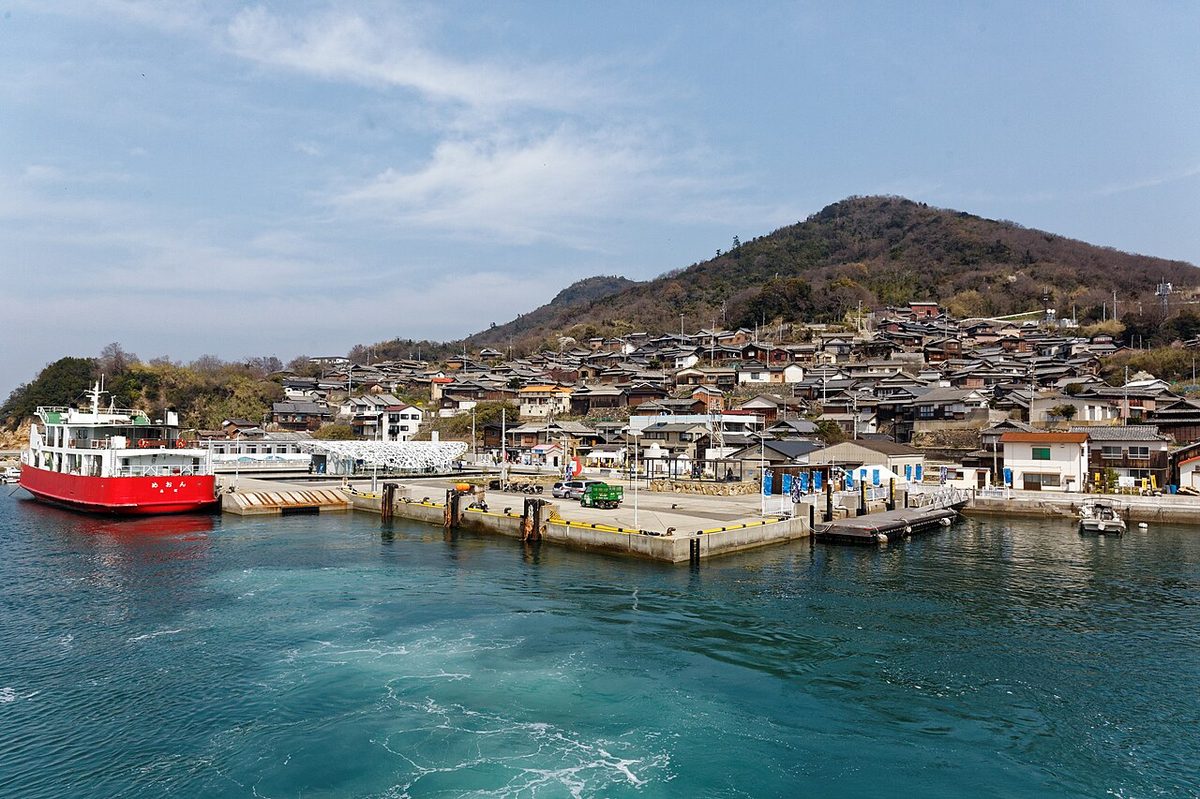

| Island group | Takamatsu Islands |
|---|---|
| Prefecture | Kagawa |
| Region | Shikoku |
| Municipality | Takamatsu |
| Population | 168 (2019) |
| Area | 1.34 km² (0.52 mi²) |
| Highest point | 213 m |
| Coordinates | 34.42833° N, 134.06111° E |
| Official site | http://ogijima.info/ |
Getting there: the article below outlines this island's usual ferry and flight routes. Timetables change with the season and sailings are cancelled in rough weather — always confirm the current schedule with the operator or the municipality before you travel.
Ogijima is an island with an area of 1.34 kilometers, located in the Hijikoku central area of Japan. We've got 168 families. I'm a member of Kagawa High-Machine Man-Man-Mama. The post code is 760-0091.
Geography
Protozoade is known for its rapid tide. It has three mountain peaks in the north and the highest is the one at the north at the altitude of 213 meters, and the highest is the peak at the second north. It's a typical indoor climate of warm weather and mild rain, and we can hardly see snow in winter. There are black pine forests, black pine forests, and there are many birds, and there are many beach plants. Ogijima does not have a natural water system, and since there is only one pond on the island because there's a small one. Because there are few flats on the island, houses are built by erecting solid stone walls on steep slopes. Geographer Hane-sama credits this view as "a curious landscape." The golden tail also wants this view to be influenced by prevailing winds, or by traffic, as well as other factors such as the Shigashima in Osaka Bay and Genkai Island.
Geological Survey
It's an open, cone - shaped lava base with stilts of rock on the granite, and basalt boulders on top of the island, and at an altitude of about 180 meters above the base of the island, there's the jubilant, basal, basal, and the rock sea of its decay. The shape of a tank four meters long, three meters wide and three meters wide from the center of the rock sea causes a column of what is called a tank rock to appear. So Ogijima column and rock sea were assigned to the city's natural monument in 1976. There are a lot of fault lines along the coast, and from there you can see the strange tissues of Pegmat and Aprit between the rough rocks, and there are also huge potholes from the head of a man to the size of a gun bath. Gyoi's hole on the upper slope of the epicenter on the west slope of Miyayama is believed to have been the result of mining the basalt volcanoes. At the pit cliff, volcanic squabbles are covered with basalt basalt, or basalt basalt, but the base of this basalt basalt basalt is crushed in a corner, which corresponds to the cracker car break at the base of the lava stream. Also, volcanic boulders are brownish brown and show that they have been air-conditioned on land for a long time. In 1931, Kentaro Hashimoto, a elementary school student in Takamashi City, compared the hole in the gii to the escape of the evil general in the Pythagorean legend. There is also water in the back of the cave, and there is a rumor that drinking will lead to senility.
The island name comes from
The island is named after a man and a woman and corresponds to the Megijima on the other side. There are also stories about the origin of the Ogijima tree, and it's also said that it comes from the castle, where the trees grow, and also from the castle, which is the defense area, and also because Mr. Aki, a member of the cloud family, settled on this island. There is also the theory that the name "The Island," derived from the fertility princess mentioned in the ancient book, has been changed. There is also a legend that the island was named after it because of the introduction of the fire that was fired by Shinichi Shinichi.
Until modern times
There are six old plants on the island, such as Kokashigi, which is a small pile of rock. OgijimaZXXZXZXXZXXZXXZXZXZXZXXXXXXXX3XXXXXXZZZZZXXXXX3XXXXXXXXXXXXXXXXXXXXXXXXXXXXXXXXXXXXXXXXXXXXXXXXXXXXXXXXXXXXXXXXXXXXXXXXXXXXXXXXXXXXXXXXXXXXXXXXXXXXXXXXXXXXXXXXXXXXXXXXXXXXXXXXXXXXXXXXXXXXXXXXXXXXXXXXXXXXXXXXXXXXXXXXXXXXXXXXXXXXXXXXXXXXXXXXXXXXXXXXXXX In the Wars of the South Seas, Mr. Takahara's founder is listed as the offering of incense with the Naoshima and the Salt Sea Islands. The next winner, Fukumoto's son, was assigned to the East in the Battle of Kanahara, and then the family name was preserved as a bannerman. Having no heir to Mr. Takahara, the fifth-grader of Mr. Takahara, he adopted Hanamoto, the eighth son of the Shiite Guard. However, he appealed to Great Britain's old wine Muyumi that the harmony was not compatible and that the harmony was "unityable to parents." But in December of 1671, when it came to it, Mr Takahara was converted, and Naoshima3 islands became empires. He ordered Ogijima and Megijima to build the platform. At first, both islands disobeyed orders because of their "nature" and Takahashi was forbidden to sell their fish products at the fish market in Takashita. The Right Gate, along with the Megijima guard, the West Wing Guard, and the Naoshima home, were allowed to build a platform. In 1882, the Ogijima Fish Council was formed. In 1895, a Ogijima lighthouse was founded at the far north end of the island. The light source of the lighthouse at that time was oil, so it required day and night maintenance, and after it was completed, two staff members, along with their families, lived here with their families and managed their lamps under a hostile environment.
Modern-day
After the end of the Pacific War in 1945, the population of Ogijima was greatly increased by withdrawal, and many houses were built. Although in the 1950s the population of the island was between 1,500 and 2,000 people, the high economic growth that followed brought many people to urban areas. By 1980, the population had dropped to 551. In 1987 the Ogijima lighthouse was disabled. The shelter that was built for the staff to sleep in was rebuilt and reusable as a library on the history of the lighthouse. In 2003 (13 years old) plans were made to plant water bulbs around this field and to make Ogijima into "Sun Send Island." For over five years, they have been planting about 360,000 square feet of cultivated land around the playwalk, such as digging up what they had grown on the island. Ogijima was actively prepared to host tourists, facilities to provide food, port public toilets and storage facilities, as well as providing vacant homes for artists to display their work. During the session, the island was visited by 956,6503 people, and an average of 919 tourists a day. The number of tourists was so large that they would make you think the island would sink, and the Ogijima was so large. Also, after this festival, there was a candidate for I turn around, and this was received as good news for future hopes. In the fall of that year, a closed male junior high school was resumed with four elementary and two junior high school students. In April 2016, a new school building with two floors of steel was completed. In 2022, six elementary school students and four middle school students studied. Ogijima is now known as Cat Island because Ogijima held the International Festival of Arts in Japan, and because of the fact that a famous animal photographer came to the picture in the same year and introduced the cats on the island. The existence of Ogijima was spread instantly on the cat's network, and 5200 tourists visited each time in 2014. But, on the other hand, since the damage to crops has been done to the growing number of cats, as well as the complaints of cat urine, and the bad smell of cats that have been exposed to the weather conditions on the island, as well as the public health condition of the cats on the island from May 30 to June, 2016, as well as the public health of the Hyogo community, the head of the Fund and 17 other cats on the island.
Leather
- It'll be under the Highland administration. It's going to be the center of Matsuyama's estate. - It's going to be a storage department. - It will be Osaka Castle's Department. - It'll be Takahashi Bank. - It will be Osaka Castle's department. - It's going to be Takahashi Bank. - It will be Osaka Castle's department. - It's going to be a storage department. It will be the High Court of Japan. May 16 - Set up the storage area. 1872) August 29th - it's under the jurisdiction of Takataka prefecture. October 5th - this will be the jurisdiction of the Cygnus prefecture. - From Ozu County to Tokugawa County. 1874) February 20th - it will be the jurisdiction of Yoichi prefecture. (Engine 876) The jurisdiction of September 5 - Kagawa 2X). 1877 - August 21st - The Second State condensation is the jurisdiction of Ehime. (Ax) December 3 - Kagawa 3X) The beginning of Akishima is on February 15th. It's going to be a Ogijima. September 30th (31) - Assembled in Takama City and become Takataka's Man-City City.
Education
If you go to city elementary and junior high school, it's going to be the school district of Takama Man's School of Men's and Mans of Takanaka's School. About the time of the end of the year 1868, the Niegawa Guard, who was a shopkeeper, opened its doors and was destroyed in 1882. In that year the temple house was opened in 1884. There were 186 children in each school, due to the overpassing of the island, 2008, in elementary school, 2011, and 2012, each middle school was closed. But the 2013 International Festival of Arts in Seto began to take on more U-turners and immigrants, and in the fall of the year, there were four families of eleven children, aged from infancy to the first grade, who began signing for a resuming of elementary school. As a result, 881 signatures and requests were submitted to resume school, and it was decided that the primary school would resume the next year. This led Ogijima elementary school to accept as a student the first time in six years, four elementary and two junior high school students. Since the old school building wasn't strong enough, the students spent two years in a temporary school near the port, but on April 8, 2016, a new steel two-story school complex was established, and the nursery was resumed as well on May 6th. At the current period of 2016, there are four students in male and male primary schools. In addition to that, in 1993, a practical supplement school was founded. This school was made up of agricultural and water-feeding departments and men's farming school in 1939.
Medical welfare
The National Health Insurance Clinic has been set up, and one doctor and three nurses work four times a week, but if you need advanced or professional medical care, you need to be treated in local hospitals. If there were emergency patients on the island, the patient would not have to make regular flights and use civilian ships to get into the harbor, but since 2010, there has been an emergency boat "A anchor" being used by Takataka City. Between 2011 and 2014, the emergency boat went out 80 times last week. As for community health activities, district health workers and health committees are working together to run health services such as health advice and visiting guidance. Ogijima and Megijima's annual health insurance requirements are 59 people and the health care rates are 25.21 percent and 21.35 percent higher than the overall rating of Takaya. Thus, on both islands, passenger fares and other services are being provided to the island people so that they can enjoy their nursing care.
The facility
The community center was maintained as a center for life's learning, but each time it became a community center. The community center is a place for activities such as community building, lifelong learning and community welfare. The administrative and administrative operations of institutions have been selected by the community council as the administrator and have been self-assembled. And at the first international art fair of the year 2010 (in the year 2010), the Man's Home of the Man's Living House, which has been organized as one of the main works of art, has served as a place of communication between visitors and artists and islanders and has contributed to the activation and tourism of the community as a symbol of the island. The library was built from a 80-year-old abandoned house on the island, and on the first floor it was built not only on the bookshelf but also on the gallery.
Other infrastructures
Since Ogijima did not have a natural water system and only had a pool and a few wells, the islanders had long been struggling to get water. The Ogijima was built in February of 1976; a water supply was built; a water supply was carried from Takataka; water was pumped out of the city; water was pumped from there by pump pressure to the water pond. But thanks to the aging of the water liners and to the unsurpassed supply systems that depend on the weather, sub-water pipes have been installed, and service has been started since April 1997. However, there are still many items on the island that don't have running water. Since 2000) garbage stations have been used to collect sensitive material corresponding to storage recycling methods, as well as the repositories and reductions of waste, to help buy compost containers. Because of the absence of sewers in Ogijima, measures are being taken to prevent the contamination of the water by living drains by providing aid to families that install integrated sewage tanks. The urine and purifying sponges are regularly collected by collectors using seams and other items.
Land traffic
The roads of Ogijima are generally narrow and steep, so car traffic is limited in part.
Manaki Port
Manaki Port serves as the island's front door port and plays an important role in the processing and evacuation of items that are built on the island that require consumption, production and other activities, as well as the evacuation of small ships. The port was organized almost in its present shape by the year 1.25, but the typhoon of 1951 (in the year 29) affected most of the facilities until the restoration of that port (in 1956).
Industrial
Since Ogijima has very little plain, agriculture is staying in the fines and growing in the fields that are stepped up stairs to the steep slope to the sea from the mountains. The rice paddies are only in a very limited area. Also, many families used to raise cattle, lend them as "borrowing cattle" during the spring season, and earn rice at the price. And there's a lot of coastal fishing to fish the sawalas and octopuses. Although the water industry in Ogijima has low fish prices due to recession, decline in consumption, and lack of successors, the flood and resource management of all Kagawa have begun to restore the fishing rate of the saguaro, and the fish that are working on the freeing business has been stable and caught.
The fishing port
The fishing port is Ogijima in the south. It was named the fishing port on March 12th. Ogijima has been known as an old island of fishing, and has been fishing around Mangiport, but since the size of the fishing boats has narrowed the harbor, since about 1965 we had built a pier and a fishing business where this harbor is now located. After receiving the 1982 fishing port, maintenance was organized on the seventh and eighth largest fishing port project in Takataka.
Tourists
The whole area is designated as the Inland Sea National Park, and many daily re-reconciliators have come for the purpose of bathing in rich natural and beautiful beaches. Also, about 11 million water plants have been planted on the walkway connecting the lighthouse library with the Gii rocks and the tank rocks. This site was held every February to March walking event, and there were about 600 people from outside the island who participated in it in February 2014. The Ogijima is the site of the International Art Festival in Seto, and some works continue to be on display after the festival's end, as the island people's access to art culture increases, the island culture is more fortunate to be re-visited. And Ogijima also promotes communication with areas centered around civil activities such as extremists and NPO, where an art festival was connected, and in addition to the NPO organizations showing on their home page how different interaction events are going to be, the islands are trying to expand the social population, such as promoting interactions with the island using the Internet itself.
Ogijima Lighthouse
The Ogijima lighthouse is located at the north end of Ogijima, 14.17 meters high, and a stone-sized lighthouse. It was built by the Japanese government in 1895. It is said that total labor cost was 1820 yen 25 yen. The Ogijima lighthouse uses a casting stone, a piece of XXQ175X, special to the Kagawa. Normally, Japanese lamps have red and white paint on their outsides, but Ogijima lamps do not use wall paint to make the materials from the silica. From 1985 to 1987, the FSA launched the Lighthouse Research Committee to provide for the maintenance of structural supplements and so forth. It revealed the historical background of the lighthouse facilities built during the X-ray period, and made its evaluation. The Ogijima lighthouse was designated as one of 23 A-level storage stations that should be considered by a special committee as one of the most valuable lighthouses in the Ogijima. Also, the lighthouse was identified as one of the inheritances of the Hijigi Akigi in 2003. On January 15th, 2026) The lighthouses, the old servants' shelters, and the old primary warehouses were designated as important cultural items in the country.
Akie Princess's shrine
A fertility goddess is said to have been founded in 1580, a Shinto shrine that serves as a fertility goddess. The islanders also call her "The Princess" with all their friendliness. It is said that if you drink alcohol at the shrine, you will be able to give birth safely. In 1817, the fertility shrine had a cast, an inducted fishing bell, and was once used as a call, a fog warning, and a call for a special gathering. Also, there is a giant tree of Ubagamasi in the border, and it is named Takamashi City's famous tree in 1997. In that year, cycassite within the border was designated as a state-specified natural monument, but because of loss, it was removed in 2007. Besides being a tourist spot on the island through the main birdhouse of the harbor, the Golden King's shrine is known as "the spot where cats can be found." There is also a temple on the island, with the honor of burning - fire shrines with the honor of being her husband.
Culture
The island is known for its openness, and it is said to have a strong disposition to welcome visitors to the island.
Customs
The fact that the International Festival of Arts in Seto gave rise to the opportunity to afford the community council, made it possible to pay off the maintenance activities of the islands, such as cutting grass. Some of the voices objected to this as not to the tradition of the Kolok. By Meiji's early days, there was an organization called the Youth of the Young, made up by boys aged 15 to 42, who conducted the festival by making a decree such as, "Acquires on the island must have a great festival to return home." And on the island, there were children's lodges, called "Neerayado," and played a large part in the collective training and human interaction of young people. As for the daughter's house, it was done away with in 1936 from "Currenting the Wind." Also on the island there was once a day when we were allowed to cut down only once a year, and on the island there was also a mountain guard to monitor it. Also, the island lady carried her baggage on her head and called it "I-T-K-I-K-K-K-K-K." Geographer Hane-sama speculates that this custom has spread because the island's alley is covered with steep slopes. He writes about marriage in the Ogijima Special Nature and Personnel X in 2727. The islanders were bound to get married at the age of sixteen to seventeen, and to be late for this was considered a great shame. The son-in-law goes to his wife's home and wants to marry her several times, but he rejects it (as customary on the part of the family). Next, the son-in-law invites his daughter-in-law, eats and so on, and wants an answer. After that, the son-in-law gets a bride from the hands of an old woman who cares for the girls and the girls. Even after they get married, the couple stay with their parents and stay separated until they have children. Some houses are said to keep their daughters away after giving birth and not send them away for three years.
Other
In addition, Ogijima is said to be the model for Okinawa Island, the scene of the novel Battle Lowire. Also, Ogijima is chosen as one of the film sites in The World Catwalk of the Immaculate Light Show. I became one of the locations in the movie. It's also one of the models for the game "Summer Packets."
TV show
Special Gaia's Witting Care Insurance
References
By the way, do you know what it's like to be in Japan? ISBN 4040013700. I'm sure you'll agree. ISBN 4041040035. I'm going to show you how to do this. INDLJP: 3030912. ISSN 02876531. "The Pygmy Tataro Research Institute" is still in good shape. ISBN 4860691032. "Kagawa" "KagawaZZZZX221XX" "A special nature and character of the XXQ 887X" - zxQ 887X "humanity and Humanities" - Volume 39, Tokuyo Geography Society, 2727, pages 213-218, ISSN 0022-35X. Nakashima ISSN 02876531. We're looking at December 20, 2010, and August 17, 2017. The Complete Report on the International Festival of Arts in Seto, December 20, 2013, and August 17, 2017. December 20, 2016, and August 17, 2017. ISSN 1341-9463. Yamada's "Third History" book, No. 10, tri-Cho University's Literature Institute, Archaeology, Japan's History Institute, pages 1-22, 2010, and March 2010. ISSN 1346-7204. https: / /ci. nii. ac. Your emails/clid/1050282676716303004#article. I'm sorry, I'm sorry. I'm sorry. ISSN 0286-8032. https: / /ci. nii. ac. Your emails/ cid/ 1520570236050444144#article.
Text adapted from the Japanese Wikipedia article 男木島, whose full text was translated into English for this guide by its contributors, licensed CC BY-SA 4.0. Population, area and location facts from Wikidata (CC0); figures Wikidata does not carry are taken from the Japanese Wikipedia article's data table (CC BY-SA 4.0).